Thursday, November 05, 2009
Tags reveal Great White Sharks' Beat
"White sharks are a large, highly mobile species," said researcher Salvador Jorgensen. "They can go just about anywhere they want in the ocean, so it's really surprising that their migratory behaviors lead to the formation of isolated populations."
Scientists with the Tagging of Pacific Predators (TOPP) program combined satellite tagging, passive acoustic monitoring and genetic tags to study great white sharks (Carcharodon carcharias) in the North Pacific. Details of their study are published in the Proceedings of the Royal Society B.
The fact that the northeastern Pacific white sharks undergo such a consistent, large-scale migration, and that they are all closely related and distinct from other known white shark populations, suggests that it is possible to conduct long-term population assessment and monitoring of these animals.
Barbara Block, professor of marine sciences at Stanford and a coauthor of the paper, said, "Catastrophic loss of large oceanic predators is occurring across many ecosystems. The white sharks' predictable movement patterns in the northeastern Pacific provide us with a super opportunity to establish the census numbers and monitor these unique populations. This can help us ensure their protection for future generations."
The researchers used a combination of satellite and acoustic tags to follow the migrations of 179 individual white sharks between 2000 and 2008. The tags reveal that the sharks spend the majority of their time in three areas of the Pacific: the North American shelf waters of California; the slope and offshore waters around Hawaii; and an area called the "White Shark Cafe," located in the open ocean approximately halfway between the Baja Peninsula and the Hawaiian Islands.
Genetics techniques were used to examine the relationships of the California sharks to all other white sharks examined globally. Studies of maternally inherited mitochondrial DNA sequences show that the populations are distinct, and suggest that the northeastern Pacific population may have been founded by a relatively small number of sharks in the late Pleistocene – within the last 200,000 years or so. The other populations of white sharks are concentrated near Australia and South Africa.
Depletion of top oceanic predators is a pressing global concern, particularly among sharks because they are slow reproducers. White sharks have been listed for international protection under the Convention on International Trade in Endangered Species (CITES) and the World Conservation Union (IUCN). Despite these precautionary listings, trade in white shark products, primarily fins, persists. Information on population and distribution of oceanic sharks is critical for implementing effective management efforts and the absence of such data impedes protection at all scales. Combining electronic tagging and genetic technologies can help protect sharks.
Further Reading:
Salvador J. Jorgensen, Carol A. Reeb, Taylor K. Chapple, Scot Anderson, Christopher Perle, Sean R. Van Sommeran, Callaghan Fritz-Cope, Adam C. Brown, A. Peter Klimley, and Barbara A. Block
Philopatry and migration of Pacific white sharks
Proc R Soc B 2009 : rspb.2009.1155v1-rspb20091155.
What do you think of this news item? Join a discussion.
Labels: marine biology, research, SCUBA News, sharks

Thursday, June 25, 2009
Third of Pelagic Sharks Threatened with Extinction
 The first study to determine the global conservation status of 64 species of open ocean (pelagic) sharks and rays reveals that 32 percent are threatened with extinction, primarily due to overfishing, according to the IUCN Shark Specialist Group.
“Despite mounting threats, sharks remain virtually unprotected on the high seas,” says Sonja Fordham, Deputy Chair of the IUCN Shark Specialist Group and Policy Director for the Shark Alliance. “The vulnerability and lengthy migrations of most open ocean sharks mean they need coordinated, international conservation plans. Our report documents serious overfishing of these species, in national and international waters, and demonstrates a clear need for immediate action on a global scale.”The report comes days before Spain hosts an international summit of fishery managers responsible for high seas tuna fisheries in which sharks are taken without limit. It also coincides with an international group of scientists meeting in Denmark to formulate management advice for Atlantic porbeagle sharks.
The study reports the Great Hammerhead (Sphyrna mokarran) and Scalloped Hammerhead (Sphyrna lewini) sharks, as well as Giant Devil Rays (Mobula mobular), as globally Endangered and facing a very high risk of extinction in the wild. Smooth Hammerheads (Sphyrna zygaena), Great White (Carcharodon carcharias), Basking (Cetorhinus maximus), Oceanic Whitetip (Carcharhinus longimanus), two species of Mako (Isurus spp.) and three species of Thresher (Alopias spp.) sharks are classed as globally Vulnerable to extinction ( facing a high risk of extinction in the wild).

Scalloped hammerhead (Sphyrna lewini)
(Image: Simon Rogerson)
Many open ocean sharks are taken mainly in high seas tuna and swordfish fisheries. Once considered only incidental “bycatch”, these species are increasingly targeted due to new markets for shark meat and high demand for their valuable fins, used in the Asian delicacy shark fin soup. To source this demand, the fins are often cut off sharks and the rest of the body is thrown back in the water, a process known as “finning”. Finning bans have been adopted for most international waters, but lenient enforcement standards hamper their effectiveness.
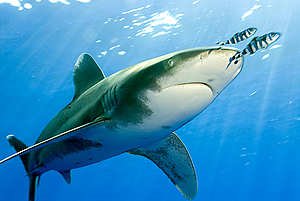
Oceanic Whitetip (Carcharhinus longimanus)
(Image: Simon Rogerson)
Sharks are particularly sensitive to overfishing due to their tendency to take many years to mature and have relatively few young. In most cases, pelagic shark catches are unregulated or unsustainable.
The IUCN Shark Specialist Group is calling on governments to set catch limits for sharks and rays based on scientific advice and the precautionary approach. It further urges governments to fully protect Critically Endangered and Endangered species of sharks and rays, ensure an end to shark finning and improve the monitoring of fisheries taking sharks and rays.

Silky (Carcharhinus falciformis)
(Image: Jeremy Stafford-Deitsch)
The IUCN uses a series of categories to classify species
| EXTINCT | The last individual has died |
| EXTINCT IN THE WILD | Only survives in captivity or cultivation |
| CRITICALLY ENDANGERED | Facing an extremely high risk of extinction in the wild |
| ENDANGERED | Facing a very high risk of extinction in the wild |
| VULNERABLE | Facing a high risk of extinction in the wild |
| NEAR THREATENED | Likely to qualify for, a threatened category in the near future |
| LEAST CONCERN | Does not qualify for any of the above |
is the world’s largest global environmental network. It is a
membership union with more than 1,000 government and
non-governmental member organisations and almost 11,000
volunteer scientists in more than 160 countries.
Further Reading:
The Conservation Status of Pelagic Sharks and Rays: Report of the IUCN Shark Specialist Group Pelagic Shark Red List Workshop
IUCN Red List Categories and Criteria booklet
Related Stories:
EU launches shark protection plan
Caribbean Big Fish Disappearing
Mediterranean Sharks Declining Fast
Mexico Passes Shark Finning Ban
Four Times more Sharks caught than Officially Reported
What do you think of this news item? Join a discussion.
Labels: fish, marine biology, research, SCUBA News, sealife, sharks
Wednesday, June 03, 2009
Snorkeller killed by shark at St Johns, Egypt
The woman's leg showed visible bite marks, and medics said she probably bled to death before being lifted to the surface.
The shark was an oceanic white tip. Although inexperienced divers sometimes confuse it with the white tip reef shark, the oceanic shark is much bigger, stockier and often accompanied by pilot fish. Whereas the reef shark is no threat to divers, the oceanic white tip is one to be wary of and treated with respect. It is almost fearless and credited with many open-ocean attacks on people after air or sea disasters.
Saint John's is in the Southern Egyptian Red Sea. It is a popular destination for divers, a place where you often see large pelagic species. If you should encounter a oceanic white tip it is advisable to stay close to the reef and not to make any sudden movements.
What do you think of this news item? Join a discussion.
Labels: Red Sea, SCUBA diving, SCUBA News, SCUBA Travel, sharks
Tuesday, May 19, 2009
New initiative to reduce shark deaths
 Today, the Shark-Marina, a not-for-profit company launches its strategy to prevent the deaths of millions of vulnerable and endangered species of shark. The initiative aims to win over the fishing community by working with game fishing societies, tackle manufacturers, competition sponsors and marinas to form community conscious policy.
In the last five years over half a million sharks on average were killed by the recreational and sport fishing community in the United States alone. Many of these were breeding age specimens and belong to vulnerable or endangered species.
The Shark-Free Marina Initiative works by prohibiting the landing of any caught shark at a participating marina. By promoting catch-and-release fishing the sport of shark fishing can actively participate in ongoing research studies and collect valuable data. The initiative is based on the Atlantic billfish model which banned the mortal take of billfish in response to population crashes in the 80's.
"Although the number of sharks killed by recreational fishermen each year is dwarfed by commercial catches, the current crisis facing shark stocks requires action wherever possible." says marine scientist and SFMI Advisor Edd Brooks "We are not asking fishermen to stop fishing, only asking them to start releasing their catch."
By collaborating with the Cape Eleuthera Institute in the Bahamas and the Fisheries Conservation Foundation in the USA, Shark-Free Marinas have already had an impact.
What do you think of this news item? Join a discussion.
Labels: sharks
Basking shark mystery solved
"While commonly sighted in surface waters during summer and autumn months, the disappearance of basking sharks during winter has been a great source of debate ever since an article in 1954 suggested that they hibernate on the ocean floor during this time," said Gregory Skomal of Massachusetts Marine Fisheries. "Some 50 years later, we have helped to solve the mystery while completely re-defining the known distribution of this species."
Using new satellite-based tagging technology, the researchers found that basking sharks make ocean-scale migrations through tropical waters of the Atlantic Ocean during the winter, travelling at depths of 200 to 1,000 meters. Their data show that the sharks sometimes stay at those depths for weeks or even months at a time.
"In doing so, they have completely avoided detection by humans for millennia," Skomal said
The discovery was the result of marking 25 basking sharks off the coast of Cape Cod with satellite tags and studying their movements. The migratory paths of the sharks were then estimated by coupling tag data with a novel geo-positioning technology technique.
Several factors had made basking sharks a challenge to study. On top of the fact that they disappear for long periods of time, they also feed exclusively on plankton. That means they can't readily be captured with traditional rod-and-reel methods. And even when the sharks are found closer to the ocean surface, they spend their time in the cool-temperature, plankton-rich waters that limit underwater visibility and make diving difficult.
The basking shark is the second largest shark after the whale shark. It filters plankton through its gills whilst swimming with its huge mouth open.
Journal Reference:
Transequatorial Migrations by Basking Sharks in the Western Atlantic Ocean. Skomal, Gregory B.; Zeeman, Stephen I.; Chisholm, John H.; Summers, Erin L.; Walsh, Harvey J.; McMahon, Kelton W.; Thorrold, Simon R.
doi:10.1016/j.cub.2009.04.019
What do you think of this news item? Join a discussion.
Labels: research, SCUBA News, sharks
Wednesday, May 06, 2009
Caribbean Big Fish Disappearing
 Sharks, barracuda and other large predatory fishes disappear on Caribbean coral reefs as human populations rise, endangering the region's marine food web and ultimately its reefs and fisheries, according to a study published today in the journal PLoS One.
While other scientists working in the Caribbean have observed the declines of large predators for decades, the new study by Chris Stallings documents the ominous patterns geographically in much more detail than other research to date.
“I examined 20 species of predators, including sharks, groupers, snappers, jacks, trumpetfish and barracuda, from 22 Caribbean nations,” said Stallings, a postdoctoral associate at the FSU Coastal and Marine Laboratory. “I found that nations with more people have reefs with far fewer large fish because as the number of people increases, so does demand for seafood. Fishermen typically go after the biggest fish first, but shift to smaller species once the bigger ones become depleted. In some areas with large human populations, my study revealed that only a few small predatory fish remain.”
Stallings said that although several factors — including loss of coral reef habitats — contributed to the general patterns, careful examination of the data suggests overfishing as the most likely reason for the disappearance of large predatory fishes across the region. He pointed to the Nassau grouper as a prime example. Once abundant throughout the Caribbean, Nassau grouper have virtually disappeared from many Caribbean nearshore areas and are endangered throughout their range.
“Large predatory fish such as groupers and sharks are vitally important in marine food webs,” Stallings said. “However, predicting the consequence of their loss is difficult because of the complexity of predator-prey interactions. You can't replace a 10-foot shark with a one-foot grouper and expect there to be no effect on reef communities. Shifts in abundance to smaller predators could therefore have surprising and unanticipated effects. One such effect may be the ability of non-native species to invade Caribbean reefs.”
A case in point, said Stallings, is the ongoing invasion by Pacific lionfish, which were introduced by aquarium releases.
“Lionfish are minor players on their native Pacific reefs, yet they are undergoing a population explosion and overeating small fishes in the greater Caribbean region,” said Professor Mark Hixon of Oregon State University, Stallings' doctoral advisor at OSU. “Preliminary evidence suggests that lionfish are less invasive where large predatory native fishes are abundant, such as in marine reserves,” Hixon said.
The study also demonstrates the power of volunteer and community research efforts by non-scientists. Stallings used data from the Reef Environmental Education Foundation's (REEF) online database, which contains fish sightings documented by trained volunteer SCUBA divers, including more than 38,000 surveys spanning a 15-year period.
Further Reading:
Fish predators of the Caribbean: the curse of too many people, Florida State University
Fishery-Independent Data Reveal Negative Effect of Human Population Density on Caribbean Predatory Fish Communities, PLoS One
What do you think of this news item? Join a discussion.
Labels: Caribbean, research, SCUBA News, sharks
Monday, February 09, 2009
EU launches shark protection plan
 The European Commission has launched a Plan of Action for the Conservation and Management of Sharks. The aim is to rebuild shark stocks and to set down guidelines for the sustainable management of the fisheries, including where shark are taken as by-catch. The plan also hopes to increase knowledge of shark stocks and shark fisheries.
European Commissioner for Maritime Affairs and Fisheries Joe Borg commented: "Sharks are very vulnerable to over-exploitation and the consequences of depleting their numbers may have very serious consequences not only for sharks but also for marine ecosystems and for fishermen themselves. That is why we have set out a plan of action which will both establish a more precautionary approach to managing fisheries where sharks are caught, and support the substantial research still needed to understand fully the role sharks play in the life of our oceans and the impact which fishing may have on them."
The Action Plan includes measures to improve data collection and to further reinforce control of the shark finning ban, which came into force in EU waters, and for all EU vessels wherever they fish, in 2003.
The Plan covers all cartilaginous fish – not only sharks, but also skates, rays and chimaeras, which make up over 1,000 species in total. They are found throughout the world, and particularly in the Northern Atlantic Ocean, where more than 50% of shark catches by EU vessels are made. Shark fisheries have grown rapidly since the mid-1980s, driven by an increased demand for shark products (fins in particular). But these species are especially vulnerable to overfishing, since they are long-lived, slow to reach sexual maturity, have long gestation periods and a low fertility rate. A recent study by the International Union for the Conservation of Nature suggests that as many as one-third of the shark species caught in EU waters are currently threatened by excessive fishing pressure. Despite the fragility of these stocks, and their growing importance to the EU fleet, EU shark fisheries have never been managed systematically.
Environmentalist organisations have broadly welcomed the plan. Steven Broad, Director of TRAFFIC, the wildlife trade monitoring network, commented "The commitment to shark conservation is to be commended, although TRAFFIC and WWF are deeply concerned that some of the measures will not be implemented for considerable periods".
Although the Plan calls for countries to collect information on sharks caught, this will be on a voluntary basis.
TRAFFIC and WWF also called on the EU to allocated adequate resources to ensure the Plan could be properly implemented, and for the Council and the European Parliament to adopt the plan without diluting the proposed measures or extending the period of implementation.
"Many of these species are already threatened with extinction. WWF and TRAFFIC are dismayed that the plan lacks a solid commitment to seek mandatory collection of data on shark catch—a critical element if the EU is to succeed in the conservation of these species," said Dr Susan Lieberman, WWF International's Species Programme Director.
Shark Alliance Policy Director, Sonja Fordham, said “The release of the long-awaited EU Shark Plan represents a great step forward for the conservation of sharks in European waters and beyond. The Plan’s commitments to science-based fishing limits, endangered species protection, and a stronger finning ban are essential to securing a brighter future for some of Europe’s most vulnerable and neglected animals.”
“The success of the EU Shark Plan depends on prompt, follow-up proposals from the Commission and cooperation from Member States in ensuring improvements are accepted and enforced,” added Fordham. “We urge all EU Fisheries Ministers to actively support timely implementation of the Shark Plan in line with scientific advice and the precautionary approach.”
Sharks are targeted by UK, French, Spanish and Portuguese fishermen; shark tails and meat are used to prepare "caldeirada" or "Schillerlocken" and shark meat is served in restaurants across Europe, and in the UK in traditional fish-and-chip shops.
Further Reading:
European Commission Fisheries
What do you think of this news item? Start a discussion.
Labels: environment, Europe, Mediterranean, SCUBA News, sealife, sharks
Thursday, June 19, 2008
Mediterranean Sharks Declining Fast
 A new scientific study has concluded that sharks in the Mediterranean Sea have declined by more than 97 percent in abundance and “catch weight” over the last 200 years.
The findings of the study published in the journal Conservation Biology, suggest several Mediterranean shark species are at risk of extinction, especially if current levels of fishing pressure continue. Study lead author Francesco Ferretti and his colleagues are concerned that the declines in sharks may have implications for the broader Mediterranean marine ecosystem.
Ferretti said: “The loss of top predators such as sharks in other sectors of the Atlantic has resulted in changes to the ecosystem. These changes are unpredictable and poorly understood but given the decline in Mediterranean shark numbers, there is cause to be seriously concerned about the effects this could have.”
Forty-seven species of sharks live in the Mediterranean Sea, of which 20 are considered top predators.
The study authors only had enough information to assess the status of five of the twenty large predatory shark species in the Mediterranean. Of those analysed, almost all of the large sharks have decreased in abundance because of unintended capture in open ocean fisheries, targeted shark fishing, and human population pressure in coastal areas. Sharks are especially vulnerable to overfishing and slow to recover from depletion because they generally grow slowly, mature late and produce few young.
The mean size of sharks caught in the Mediterranean is among the lowest in the world. The study reveals that size and weight declines over time indicate that more young and immature sharks are being caught.
There are currently no catch limits for commercially-fished shark species in the
Mediterranean Sea. A comprehensive monitoring program for fisheries has been difficult to implement in the Mediterranean because of the artisanal (small and localized) nature of its fisheries and the large number of countries bordering the sea.
Only five species of sharks offered sufficient information for analysis, including the blue shark, one thresher shark species, two mackerel shark species and one hammerhead shark species. The blue, smooth hammerhead and thresher sharks were classified as “Vulnerable” according to the latest IUCN-World conservation Union Red List Criteria for extinction risk. Two mackerel sharks, porbeagle and shortfin mako, were classified as “critically endangered”. Many other large sharks are classified as “Data Deficient”.
To view a summary of the Conservation Biology paper, visit:
http://www.lenfestocean.org/publications/ferretti_med_sharks.html
-
What do you think of this news item? Start a discussion.
Bookmark with: del.icio.us | Digg | Newsvine | NowPublic | Reddit
|
 Slashdot It! | Facebook | StumbleUpon
 --
Subscribe to SCUBA News (ISSN 1476-8011) for more free news, articles, diving reports and marine life descriptions - http://www.scubatravel.co.uk/news.html

Labels: environment, Mediterranean, research, sharks
Friday, March 09, 2007
Mexico Passes Shark Finning Ban
"Mexico has taken a real leadership position here" says Patric Douglas CEO of Shark Diver (www.sharkdiver.com). "The rest of Latin America is watching what Mexico does with great interest now, this is good news indeed".
In the past few years Mexico has been recognized as one of the few places on the planet where large congregations of Great White sharks appear each year at Isla Guadalupe. Along with Whale shark aggregations in Holbox, destination tourism with these shark species and others is growing.
Captain Mike Lever owner of expedition dive vessel MV Nautilus Explorer was thrilled at the news "The people of Mexico afford us a great privilege in allowing us to dive with the white sharks at Guadalupe Island. The February 14th enactment of Mexican rules for responsible shark and ray fisheries is incredibly good news and really bodes well for the survival of these magnificent animals. Our hats are off to all of the scientists who helped make this happen".
The new rules and regulations came after 10 years of debate and the broad support of researchers, scientists, conservations groups, eco-tour operations and local citizens.
What do you think of this news item? Start a discussion.
--
Subscribe to SCUBA News (ISSN 1476-8011) for more free news, articles, diving reports and marine life descriptions - http://www.scubatravel.co.uk/news.html
Labels: environment, sealife, sharks
Thursday, October 05, 2006
Four Times more Sharks caught than Officially Reported
Researchers looked at trade in shark fins, and used genetic identification to estimate by species the number of globally traded shark fins.
The results are the first fishery-independent estimate of the scale of shark catches worldwide. If the estimates are correct for one of the most commonly traded species, the blue shark, then the nubers being caught are very close to the maximum sustainable levels.
Increasing awareness of the vulnerability of shark species to exploitation and a proliferation of finning (i.e. removal of fins and discarding of the carcass at sea) have contributed to growing concerns that the fin trade may be driving shark catches to unsustainable levels.
The research was led by Shelley Clarke of Imperial College London who has lived in Asia for over 12 years.
Hong Kong is world's largest shark fin market with at least half of the global trade.
Sources:
Ecology Letters, Volume 9, Number 10, October 2006, pp. 1115-1126(12)
Conservation Biology Volume 20, No. 1, 201–211
--
Subscribe to SCUBA News (ISSN 1476-8011) for more free news, articles, diving reports and marine life descriptions - http://www.scubatravel.co.uk/news.html
Thursday, April 27, 2006
New Hammerhead Shark Found
A recent study into scalloped hammerhead sharks, Sphyrna lewini, shows that although the fish in the Atlantic and Indo-Pacific populations appear identical, genetically they are different. The scalloped hammerhead in the western north Atlantic is actually a new, cryptic, species.
The study concludes that effective management of large coastal shark species should incorporate this discovery. It indicates that the cryptic scalloped hammerhead is less abundant than S. lewini, making it potentially more susceptible to fishery pressure.
Journal Reference: Marine Biology, Volume 148, Issue 5, Mar 2006
--
Subscribe to SCUBA News (ISSN 1476-8011) for more free news, articles, diving reports and marine life descriptions - http://www.scubatravel.co.uk/news.html
Labels: sharks
Wednesday, February 15, 2006
Shark Attacks Fall in 2005
Shark attacks dropped in 2005 because people are fighting back when attacked and shark populations are decreasing, according to a University of Florida report.
Worldwide there were 58 shark attacks in 2005, of which only 4 were upon divers. This is down from 78 attacks in 2000.
Part of the reason for the trend is that there are fewer sharks, a result of a decline caused by overfishing of this slow-to-reproduce animal. The other factor is that people are defending themselves more aggressively.
What should you do as a diver if you see a shark? George H. Burgess of the International Shark Attack File advises you to
"Stay calm and maintain your position in as quiet a manner as possible. Most sharks merely are curious and will leave on their own accord. Enjoy your opportunity to see one of nature's most magnificent predators.
If a shark begins to get too interested, the best strategy is to leave the water watching the shark all the time, with your dive partner close at hand. Sharks are less likely to attack a 'school' of divers than a solitary individual."
He goes on to say that if the shark is acting overtly aggressive then back up against whatever structure (reef, rock outcropping, piling) is available. If you are in open water, orient back-to-back with your dive partner and gradually rise to the surface and the safety of your boat.
If a shark attacks, the best strategy is to hit it on the tip of its nose. If it bites then be as agressive as possible and claw at the eyes and gill openings.
Further Reading: International Shark Attack File
--
Subscribe to SCUBA News (ISSN 1476-8011) for more free news, articles, diving reports and marine life descriptions - http://www.scubatravel.co.uk/news.html
Labels: sharks
Saturday, October 08, 2005
Shark Travels from Africa to Australia and Back

A great white shark, nicknamed Nicole, has made the journey between South Africa and Australia and back in under nine months. The new research published in Science is the first proof of links between populations of different continents.
"This is one of the most significant discoveries about white shark ecology and suggests we might have to rewrite the life history of this powerful fish," said researcher Dr. Ramon Bonfil, shark expert and lead author of the study. "More importantly, Nicole has shown us that separate populations of great white sharks may be more directly connected than previously thought, and that wide-ranging white sharks that are nationally protected in places such as South Africa and Australia are much more vulnerable to human fishing in the open oceans than we previously thought."
The story of Nicole began on November 7, 2003, when Bonfil and his colleagues from the Marine and Coastal Management Department of South Africa and the White Shark Trust attached a satellite tag to Nicole’s dorsal fin as part of a large study on white shark migrations. The tags—specifically known as pop-up archival tags—record data on time, temperature, water depth, and light levels as the shark moves through its habitat. On a pre-recorded date, the tag detaches from the shark and floats to the surface, where it transmits its data sets to a researcher’s computer via satellite.
An additional 24 white sharks were tagged with similar tags and seven more with real-time satellite tags during this study, with Bonfil and his team often having to wrestle the dangerous sharks while on a cradle in order to fix the satellite transmitters to their dorsal fins. While most of the tagged white sharks revealed at least three different movement patterns, including wide-ranging coastal migrations up and down the eastern side of South Africa, Nicole headed out into the vast and deep basin of the Indian Ocean. The track estimated from the data transmitted by the tag revealed that Nicole followed a strikingly direct route towards Australia, on a path void of oceanic islands. Although Nicole took frequent plunges to depths as great as 3,215 feet (980 meters—a record for white sharks) while crossing the Indian Ocean, she spent most of her time (61 percent) swimming along the surface, leading researchers to suspect that perhaps great white sharks use celestial cues for transoceanic navigation.
Ninety-nine days later, Nicole was swimming about a mile from shore just south of the Exmouth Gulf in western Australia, where her tag detached and floated to the surface with all of her secrets.
This leg of the journey alone—some 6,897 miles (11,100 kilometers)—was one for the record books. However, Nicole would resurface again on August 20, 2004, not in Australian waters, but back in Gansbaai, South Africa, where she was tagged just under nine months before. Her distinctively notched dorsal fin was photographed by Michael Scholl, one of Bonfil’s team researchers and compared to previous photographs he had taken over a period of six years. After a detailed comparison of images of dorsal fin notches and markings, there was no longer any doubt: Nicole had returned to her home waters.
--
Subscribe to SCUBA News for more free news, articles, diving reports and marine life descriptions - http://www.scubatravel.co.uk/news.html
No More Shark Fishing in Red Sea
A recently issued Eyptian decree will finally ban shark fishing in the Red Sea. This gives the conservation association HEPCA the legislative means to put a stop to the dozens of shark massacres that are reported daily throughout Egypt's Red Sea coastline from Hurghada to Marsa AlamShark fishing has, theoretically, been illegal since 1973, when Egypt became one of 100 countries to sign the CITES (Convention of International Trading of Endangered Species) Treaty. Sharks in the Red Sea were on CITES' list of endangered species, but the Egyptian law that regulates fishing made no mention of sharks.
"Sharks are a valuable source of revenue for the country. Many people don’t realize that tourists spend millions of dollars in the Red Sea because of the sharks. For example, a dive destination like the Brother Islands (off the coast of Marsa Alam) is sold primarily because of its abundant shark population. It has been estimated that each shark in the Red Sea generates approximately 10,000 pounds sterling in income to the country," said HEPCA's Director.
The problem began to reach alarming levels in 2000, when divers and conservationists started noticing a marked decrease in shark populations. The decline in numbers was mainly attributed to an increase in the number of fishing boats in the Red Sea.
This new wave of commercial fishing, coupled with the rise of a handful of trading companies that were being established solely for the purpose of exporting in-demand seafood delicacies (including sea cucumbers and shark fins) to the Chinese market, were an environmental catastrophe in the making.
It is difficult to quantify Egypt’s current shark population and how much it has suffered over the years, but divers claim that sites near Sharm El-Sheikh and Hurghada that have always been known as prime shark viewing destinations are becoming less and less inhabited with by sharks.
More info: http://www.egypttoday.com/article.aspx?ArticleID=5918
--
Subscribe to SCUBA News for more free news, articles, diving reports and marine life descriptions - http://www.scubatravel.co.uk/news.html
