Thursday, March 04, 2010
Barnacle Dinner in the Galapagos
Working at an expansive range of underwater sites in the Galapagos, marine ecologist Jon Witman and his team found that at two sub-tidal depths, barnacle larvae had latched onto rock walls, despite the vertical currents. In fact, the stronger the vertical current, the more likely the barnacles would colonize a rocky surface.
The researchers also documented the presence of whelks and hogfish, which feast on barnacles. This predator-prey relationship shows that vertical upwelling zones are “much more dynamic ecosystems in terms of marine organisms than previously believed,” Witman said.
Scientists who study coastal marine communities had assumed that prey species such as barnacles and mussels would be largely absent in vertical upwelling areas, since the larvae, which float freely in the water as they seek a surface to attach to, would more likely be swept away in the coast-to-offshore currents. Studies of the near-surface layer of the water in rocky tidal zones confirmed that thinking. But the field work by Witman and his group, in deeper water than previous studies, told a different tale: Few barnacles were found on the plates in the weak upwelling zones, while plates at the strong upwelling sites were teeming with the crustaceans. Flourishing barnacle communities were found at both the 6-meter and 15-meter stations, the researchers reported.
The scientists think the free-floating larvae thrive in the vertical-current zones because they are constantly being bounced against the rocky walls and eventually find a tranquil spot in micro crevices in the rock to latch on to.
Further Reading
Coupling between subtidal prey and consumers along a mesoscale upwelling gradient in the Galápagos Islands. Jon D. Witman, Margarita Brandt, Franz Smith. Ecological Monographs 2010 80:1, 153-177
Brown University News, Barnacles Prefer Upwelling Currents, Enriching Food Chains in the Galapagos
Labels: Galapagos, marine biology, research, SCUBA News

Monday, February 22, 2010
Sea of Cortez Threatened
 Life in the Sea of Cortez is endangered by destructive new fishing methods.
Ten years ago graduate students Octavio Aburto-Oropeza and Gustavo Paredes surveyed the marine life of the Sea of Cortez (also known as the Gulf of California). In 2009 they went back and were shocked at how things had declined. Sixty percent of the surveyed sites showed signs of degradation, according to Aburto-Oropeza, and many are now missing the top predators normally present in healthy, functioning ecosystems.
"Ten years later we can actually measure the effects of not putting conservation measures in place," Paredes told Explorations Magazine. "Some of us had been conducting surveys in certain sites every year, but until this year we didn't know the whole story of what was going on."
The changes have occurred because of fishing. Traditional hook-and-line fisherman have been put out of business by vastly more damaging gill net fishing and "hookah" diving. Hookah fishermen use surface-supplied air through piping that allows them to walk along the seafloor for long periods of time. The technique is typically conducted at night when fish are resting, allowing the hookah fishermen to spear or grab large numbers of vulnerable fish and invertebrates.
In the most dramatic example of fishing impacts observed on the 2009 expedition a survey of San Esteban Island in the north revealed reefs devoid of fish and instead covered by mats of cyanobacteria.
There are areas which have flourished, though. One example is Cabo Pulmo near the southern tip of the Baja peninsula. Fishing restrictions there since 1995 have ensured that Cabo Pulmo retains a mix of sea life and flourishing fish populations. Other successes include Coronado Island inside the Loreto marine park and Los Islotes inside Espiritu Santo marine park.
Using compressed air has been banned in Mexico for sports fishermen for 40 years, but since commercial fishermen weren’t named specifically they had been allowed to use compressed air to clean the reef. In May 2009 this changed: the use of hookahs have now been outlawed for any type of fishing. Illegal fishing still goes on though, and environmental organisation Sea Watch is asking people to report any that they encounter at http://seawatch.org/en/Resource-Library/359/report-illegal-fishing
Further Reading:
Scripps Institution of Oceanography
Labels: dive destination, environment, research, SCUBA diving, SCUBA News, SCUBA Travel
Wednesday, January 20, 2010
Red Grouper create home for many animals
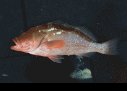 Researchers from Florida State University have found that Red Grouper (Epinephelus morio) dig out and maintain complex structures at the bottom of the sea. They remove sand, exposing hard rocks that are crucial to corals and sponges and the animals that rely on them. The work demonstrates that Red Groupers modify their environment, much as beavers do, creating habitat for many other animals including lobster and commercially important fish.
"Watching these fish dig holes was amazing enough,” says Felicia Coleman, lead researcher, “but then we realised that the sites served to attract mates, beneficial species such as cleaner shrimp that pick parasites and food scraps off the resident fish and a variety of prey species for the Red Grouper. So it's no surprise that the fish are remarkably sedentary. Why move if everything you need comes to you?”
“The research is incredibly valuable because it demonstrates how interconnected species are in the sea,” says Dr. Susan Williams, a professor at the University of California, Davis. “Red Groupers are the 'Frank Lloyd Wrights' of the sea floor because they are critical habitat architects. The species that associate with them include commercially valuable species- such as vermilion snapper, black grouper, and lobsters. If the groupers are overfished, the suite of species that depends on them is likely to suffer.”
Working along the West Florida Shelf, the authors observed the excavating behaviour of the Red Grouper during both their juvenile stage in inshore waters as their adult stage at depths of 100 m. The study serves to document this behaviour and its apparent impact on the biological diversity of the ocean. Their article on the study, “Benthic Habitat Modification through Excavation by Red Grouper, Epinephelus morio, in the Northeastern Gulf of Mexico,” is published in the most recent issue of the journal The Open Fish Science Journal.
Red Grouper (Epinephelus morio) is an economically important species in the reef fish community of the southeastern United States, and especially the Gulf of Mexico. It is relatively common in karst regions of the Gulf.
As juveniles, Red Grouper excavate the limestone bottom of Florida Bay and elsewhere, exposing “solution holes” formed thousands of years ago when sea level was lower, and freshwater dissolved holes in the rock surface. When sea level rose to its present state, these solution holes filled with sediment. By removing the sediment from these holes, Red Grouper restructure the flat bottom into a three dimensional matrix.
Spiny lobsters are among the many species that occupy these excavations, especially during the day when they need refuge from roving predators.
“What are the consequence of overfishing these habitat engineers?” asks co-author Koenig. “You can't remove an animal that can dig a hole five meters across and several meters deep to reveal the rocky substrate and expect there to be no effect on reef communities. The juveniles of a species closely associated with these pits, vermilion snapper, are extremely abundant around the offshore excavations. It is possible that the engineered habitat is significant as a nursery for this species, which other big fish rely on as food. One could anticipate a domino effect in lost diversity resulting from the loss of Red Grouper-engineered habitat.”
Red Grouper clearly remove sufficient sediment to transform an otherwise two-dimensional area into a three-dimensional structure below the seafloor, providing refuge for themselves and for other organisms. In the process, they expose hard substrate, thus creating settlement sites for corals, sponges, and anemones, allowing the creation of three-dimensional structure above the seafloor as well. Addition of these roles to their contribution as resident top predators suggests that they might have a disproportionately large per capita influence on the ecosystem within which they live.
Red Grouper have been harvested in the United States since the 1880s and are currently the most common grouper species landed in both commercial and recreational fisheries of the Gulf of Mexico.
Excessive fishery removals can and often do have cascading effects in marine communities that ultimately result in the loss of many species. This situation arises when the captured species has a disproportionately large influence on the system within which it lives. The Red Grouper has been shown to be one such species.
Further Reading:
Benthic Habitat Modification through Excavation by Red Grouper, Epinephelus morio, in the Northeastern Gulf of Mexico
pp.1-15 (15) Authors: Felicia C. Coleman, Christopher C. Koenig, Kathryn M. Scanlon, Scott Heppell, Selina Heppell, Margaret W. Miller
doi: 10.2174/1874401X01003010001
Florida State University
What do you think of this news item? Join a discussion.
Labels: America, coral, fish, marine biology, research, SCUBA News
Tuesday, January 19, 2010
Minke Whales Should Not be Culled
Antarctic minke whales are among the few species of baleen whales not decimated by commercial whaling during the 20th century, and some scientists have hypothesised that their large numbers are hampering the recovery of deleted species, such as blue, fin and humpback, which may compete for krill.
This “Krill Surplus Hypothesis” postulates that the killing of some two million whales in the Southern Ocean during the early- and mid-20th century resulted in an enormous surplus of krill, benefiting the remaining predators, including Antarctic minke whales.
But the new analysis, published this week in the journal Molecular Ecology, estimates that contemporary populations of minke whales are not “unusually abundant” in comparison with their historic numbers.
The Southern Ocean is one of the world’s largest and most productive ecosystems and in the 20th century went through what Scott Baker, a whale geneticist at Oregon State University, called “one of the most dramatic ‘experiments’ in ecosystem modification ever conducted.” The elimination of nearly all of the largest whales – such as the blue, fin and humpback – removed a huge portion of the biomass of predators in the ecosystem and changed the dynamics of predator-prey relationships.
Blue whales were reduced to about 1-2 percent of their previous numbers; fin whales to about 2-3 percent; and humpbacks to less than 5 percent. “The overall loss of large whales was staggering,” Baker said.
“It is possible that the removal of the larger whales would have meant more food for minkes,” Baker said, “but we don’t know much about the historic abundance of krill and whether the different whale species competed for it in the same places, or at the same time. It is possible that there might have been enough krill for all species prior to whaling.”
The scientists also say that current minke whale populations may be limited by other factors, including changes in sea ice cover.
“The bottom line is that the Krill Surplus Hypothesis does not appear to be valid in relation to minke whales and increasing hunting based solely on the assumption that minke whales are out-competing other large whale species would be a dubious strategy,” Baker said.
Further Reading: Oregon State University
What do you think of this news item? Join a discussion.
Labels: marine biology, research, SCUBA News, whale and dolphins
Thursday, December 10, 2009
IUCN warns of acid oceans
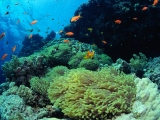 Increased release of carbon dioxide in the atmosphere is making seawater more acidic and is threatening ecosystems and species. It is also reducing the ocean’s ability to absorb carbon dioxide and regulate climate. According to IUCN (International Union for Conservation of Nature), deep and immediate cuts in emissions are needed to stall the acidification of oceans and prevent mass extinction of marine species.
There can be little doubt that the ocean is undergoing dramatic changes that will impact many human lives now and in coming generations, unless we act quickly and decisively. Previous episodes of ocean acidification were linked to mass extinctions of some species and it is reasonable to assume that this episode could have the same consequences.
The ocean provides about half of the Earth’s natural resources and humankind takes direct advantage of this through our fisheries and shellfisheries. The ocean also absorbs 25 percent of all the carbon dioxide we emit each year, and produces half the oxygen we breathe.
Ocean acidity has increased by 30 percent since industrialisation began 250 years ago. If CO2 levels in the atmosphere continue to rise, sea water acidity could increase by 120% by 2060 – greater than anything experienced in the past 21 million years. By 2100, 70% of cold water corals may be exposed to corrosive water.
Given the lag between CO2 emissions and a stabilisation of acidification, it could take tens of thousands of years before the ocean’s properties are restored and even longer for full biological recovery. This demands immediate and substantial emissions cuts and technology that actively removes CO2.
“There is an increasingly real and very urgent need to dramatically cut emissions. The ocean is what makes Earth habitable and different from anywhere else we know in our solar system and beyond – now’s the time to act to minimise the impacts on our life support system while we still have time,” says Carl Gustaf Lundin, Head of IUCN’s Global Marine Programme.
Further Reading
Ocean Acidification - The Facts.
What do you think of this news item? Join a discussion.
Labels: environment, research, SCUBA News
Monday, December 07, 2009
King Crab Family Grows
javascript:void(0)
The new species are Paralomis nivosa from the Philippines, P. makarovi from the Bering Sea, P. alcockiana from South Carolina, and Lithodes galapagensis from the Galapagos archipelago – the first and only king crab species yet recorded from the seas around the Galapagos Islands.
King crabs were first formally described in 1819. They include some of the largest crustaceans currently inhabiting the Earth. They are known from subtidal waters in cooler regions, but deep-sea species occur in most of the world’s oceans, typically living at depths between 500 and 1500 metres.
Many more species of King Crab remain to be discovered. “The oceans off eastern Africa, the Indian Ocean and the Southern Ocean are all particularly poorly sampled,” said Hall: “We need to know which king crab species live where before we can fully understand their ecology and evolutionary success.”
Further Reading
National Oceanography Centre, Southampton
What do you think of this news item? Join a discussion.
Labels: marine biology, research, SCUBA News
Wednesday, December 02, 2009
'Shocking' 95% Decline of Fish Populations
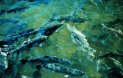 Populations of numerous migratory fish species - those that move between freshwater and saltwater during the course of their lives - have declined by more than 95 percent in the North Atlantic . This threatens food supplies and economic systems, and is worse than was thought as people have tended to compare numbers over too short time scales, according to a paper published this month in the journal BioScience.
 "It's shocking," said Dr. Karin Limburg, a fisheries ecologist at the SUNY College of Environmental Science and Forestry in Syracuse, N.Y., who is the paper's lead author.
Limburg and her co-author report that a combination of habitat loss (caused largely by the construction of dams that prevent fish access to traditional spawning areas), urban sprawl, overfishing, pollution and climate change have led to the precipitous decline. Compounding the problem, they say, is the evolving knowledge of the humans who make decisions about how natural resources are managed.
"We're looking at shifting baselines here," Limburg said. "Every human generation gains knowledge about the world and establishes a baseline for what's normal. But there is no institutional memory about how things used to be."
As an example, Limburg pointed to a graph that depicts the status of the American shad between 1887 and 1997. It indicates the species was more than 10 times as plentiful during most of the early years of that period as it was during the middle of the 20th century. But a second chart shows that the levels in the 1880s were just 10 percent of what they had been 50 years earlier.
"We can't envision salmon being a thing of the past," she said. "That was once the case with shad. It was the most important fish in U.S. fisheries, after cod." In fact, the shad's Latin name (Alosa sapidissima) reflects the species' high status as a food fish: "sapidissima" means "most delicious."
In their findings, the authors wrote: "Loss of historical baselines contributes to marginalization of the species, as social customs relating to bygone (collapsed) fisheries also perish, and ecosystems unravel at rates that go unnoticed."
Declines were seen in all but two of the fish populations studied. Striped bass, already the subject of protective measures, increased in North America, and lampreys were found to be more abundant in some rivers in France.
The analysis showed that the once-abundant allis shad, a member of the herring family that lives most of its life in coastal waters but migrates into rivers to spawn, plummeted by 99.9 percent in the Rhine River in the Netherlands between 1886 and 1933; the same species dropped by 99.4 percent in the Minho River in Portugal between 1925 and 1988. The European eel's population plunged 95.4 percent in the Ems River, which flows through the Netherlands and Germany, and in the Vidå River in Denmark between 1960 and 1997; it decreased by 99.5 percent in the Yser River in Belgium between 1974 and 2004
When viewed as a group, the magnitude of the migratory species' declines appears even more serious than that of marine predatory fishes, which has received far more attention, Limburg said.
She said the study highlights the importance of a relatively new school of thought in the scientific community: ecosystem services.
"We want to put this in the context of the new way many ecologists are now thinking, to say that ecosystems have a value by themselves," Limburg said.
In particular, she said, the study highlights the interwoven relationship between marine and freshwater ecosystems. The two are linked in the North Atlantic by the 24 species of fish whose populations were analyzed; they are migratory fish that move between freshwater and saltwater during the course of their lives. "Sadly, the links are largely broken today because of the enormity of declines in abundances," she said.
The findings were reported after Limburg and Waldman analyzed data formerly reported in scholarly literature and collected over the years by government agencies and management organizations in nations whose waters flow into the North Atlantic basin, which includes the Atlantic Ocean north of the equator, plus the Caribbean Sea and the Gulf of Mexico.
Further Reading:
SUNY College of Environmental Science and Forestry
What do you think of this news item? Join a discussion.
Labels: fish, research, SCUBA News
Wednesday, November 11, 2009
Swarms of ocean robots to monitor oil spills
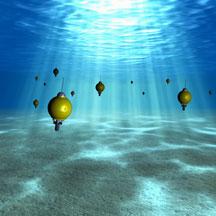 Swarms of miniature robotic ocean explorers that could one day help predict where ocean currents will carry oil spills, and which marine areas should be protected.
These autonomous underwater drifters will trace the fine details that can determine underwater ocean currents of a few kilometers. These are important for understanding marine protected areas, algal blooms, oil spills and the path sewage takes after it is pumped into the ocean.
"Maybe there has been an oil spill in the ocean and we want to establish very quickly how and where the spill might move. We are developing the algorithms that will keep a swarm of autonomous underwater explorers (AUEs) coordinated so they can follow the flow of the ocean currents and give us data on the spill as it is moving around," explained Jorge Cortes, a professor in the Mechanical and Aerospace Engineering Department at the UC San Diego Jacobs School of Engineering.
In addition to predicting where oil will travel, scientists can use this information on the flow of ocean currents in order to improve their models—and ultimately their understanding—of how ocean currents operate on the scale of kilometers and what this means for ocean life and for determining where marine protected areas should be established.
According to Jules Jaffe and Peter Franks, the two Scripps Institution of Oceanography researchers, the robot swarms could aid in science’s development of marine protected areas by following currents for determining critical nursery habitats and for tracking harmful blooms of algae.
The project differs from related work on networks of underwater robots in that the robot swarms the UCSD researchers are developing are significantly smaller and less expensive. At the same time, these robot swarms will be far more capable of making use of the information they collect on the fly in order to improve the accuracy of their task at hand.
Small armies of such robots will concurrently map currents and sense the environment. The robots relay their sensed data when they surface.
The robots will work through a system under which several football sized devices are deployed in conjunction with many—tens or even hundreds—of pint-sized underwater explorers. As they move about the ocean, the smaller-sized robots will use acoustic transmissions from the "motherships" to ascertain their positions. Collectively, the entire swarms of robots will help track fine ocean currents and flows that organisms at the small scale, tiny abalone larvae, for example, experience in the ocean.
"AUEs (Autoonomous Underwater Explorers) will give us information and statistics to figure out how the small organisms survive, how they move in the ocean and the physical dynamics they experience as they get around," said Franks. "AUEs should improve our ocean models and eventually allow us to do a better job of following the weather and climate of the ocean, as well as help us understand things like carbon fluxes."
Franks, who conducts research on marine phytoplankton, among other areas, says the new concentration on dense sampling at small scales will help resolve some of the patchiness in understanding the physical and biological properties on those scales.
"Plankton are somewhat like the balloons of the ocean floating around out there," he said. "We are trying to figure out how the ocean works at the scales that matter to the plankton. You put 100 of these AUEs in the ocean and let 'er rip. We'll be able to look at how they spread apart and how they move to get a sense of the physics driving the flow."
Further Reading:
UC San Diego Jacobs School of Engineering
National Science Foundation
Ocean Research Robots: A Future Vision for Ocean Observation
What do you think of this news item? Join a discussion.
Labels: environment, research, SCUBA News, technology
Thursday, November 05, 2009
Tags reveal Great White Sharks' Beat
"White sharks are a large, highly mobile species," said researcher Salvador Jorgensen. "They can go just about anywhere they want in the ocean, so it's really surprising that their migratory behaviors lead to the formation of isolated populations."
Scientists with the Tagging of Pacific Predators (TOPP) program combined satellite tagging, passive acoustic monitoring and genetic tags to study great white sharks (Carcharodon carcharias) in the North Pacific. Details of their study are published in the Proceedings of the Royal Society B.
The fact that the northeastern Pacific white sharks undergo such a consistent, large-scale migration, and that they are all closely related and distinct from other known white shark populations, suggests that it is possible to conduct long-term population assessment and monitoring of these animals.
Barbara Block, professor of marine sciences at Stanford and a coauthor of the paper, said, "Catastrophic loss of large oceanic predators is occurring across many ecosystems. The white sharks' predictable movement patterns in the northeastern Pacific provide us with a super opportunity to establish the census numbers and monitor these unique populations. This can help us ensure their protection for future generations."
The researchers used a combination of satellite and acoustic tags to follow the migrations of 179 individual white sharks between 2000 and 2008. The tags reveal that the sharks spend the majority of their time in three areas of the Pacific: the North American shelf waters of California; the slope and offshore waters around Hawaii; and an area called the "White Shark Cafe," located in the open ocean approximately halfway between the Baja Peninsula and the Hawaiian Islands.
Genetics techniques were used to examine the relationships of the California sharks to all other white sharks examined globally. Studies of maternally inherited mitochondrial DNA sequences show that the populations are distinct, and suggest that the northeastern Pacific population may have been founded by a relatively small number of sharks in the late Pleistocene – within the last 200,000 years or so. The other populations of white sharks are concentrated near Australia and South Africa.
Depletion of top oceanic predators is a pressing global concern, particularly among sharks because they are slow reproducers. White sharks have been listed for international protection under the Convention on International Trade in Endangered Species (CITES) and the World Conservation Union (IUCN). Despite these precautionary listings, trade in white shark products, primarily fins, persists. Information on population and distribution of oceanic sharks is critical for implementing effective management efforts and the absence of such data impedes protection at all scales. Combining electronic tagging and genetic technologies can help protect sharks.
Further Reading:
Salvador J. Jorgensen, Carol A. Reeb, Taylor K. Chapple, Scot Anderson, Christopher Perle, Sean R. Van Sommeran, Callaghan Fritz-Cope, Adam C. Brown, A. Peter Klimley, and Barbara A. Block
Philopatry and migration of Pacific white sharks
Proc R Soc B 2009 : rspb.2009.1155v1-rspb20091155.
What do you think of this news item? Join a discussion.
Labels: marine biology, research, SCUBA News, sharks
Friday, October 09, 2009
Albatrosses feed with Killer Whales
A miniature digital camera was attached to the backs of four black-browed albatrosses (Thalassarche melanophrys). Results are published online this week in the open-access journal PLoS ONE.
Albatrosses fly many hundreds of kilometers across the open ocean to find and feed upon their prey. Despite the growing number of studies concerning their foraging behaviour, relatively little is known about how albatrosses actually locate their prey. The still images recorded from the cameras showed that some albatrosses actively followed a killer whale (Orcinus orca), possibly to feed on food scraps left by this diving predator. The camera images together with the depth profiles showed that the birds dived only occasionally, but that they actively dived when other birds or the killer whale were present. This association with diving predators or other birds may partially explain how albatrosses find their prey more efficiently in the apparently ‘featureless’ ocean, with a minimal requirement for energetically costly diving or landing activities.
The camera, developed by the National Institute for Polar Research in Tokyo, is removed when the albatross returns to its breeding ground after foraging trips. It is small and weighs 82g. Although the camera slightly changes the aerodynamic shape of the albatross, it didn’t affect the breeding success of the study birds.
Dr Richard Phillips from British Antarctic Survey (BAS) says, “These images are really interesting. They show us that albatrosses associate with marine mammals in the same way as tropical seabirds often do with tuna. In both cases the prey (usually fish) are directed to the surface and then it’s easy hunting for the birds."
The study took place at the breeding colony of black-browed albatrosses at Bird Island, South Georgia in January 2009, as part of a UK-Japan International Polar Year 2007-9 project.
What do you think of this news item? Join a discussion.
Labels: research, SCUBA News, whale and dolphins
Monday, September 21, 2009
Arctic Sea Ice Reaches 2009 Low
While this year's September minimum extent was greater than each of the past two record-setting and near-record-setting low years, it is still significantly below the long-term average and well outside the range of natural climate variability, said NSIDC Research Scientist Walt Meier. Most scientists believe the shrinking Arctic sea ice is tied to warming temperatures caused by an increase in human-produced greenhouse gases being pumped into Earth's atmosphere.
Atmospheric circulation patterns helped the Arctic sea ice spread out in August to prevent another record-setting minimum, said Meier. But most of the 2009 September Arctic sea ice is thin first- or second-year ice, rather than thicker, multi-year ice that used to dominate the region, said Meier.
The minimum 2009 sea-ice extent is still about 620,000 square miles below the average minimum extent measured between 1979 and 2000 -- an area nearly equal to the size of Alaska, said Meier. "We are still seeing a downward trend that appears to be heading toward ice-free Arctic summers," Meier said.
Further Reading:
National Snow and Ice Data Center
What do you think of this news item? Join a discussion.
Labels: environment, research, SCUBA News
Friday, September 11, 2009
Rare Algae Saves Caribbean Coral
 A rare opportunity has allowed a team of scientists to evaluate corals--and the essential, photosynthetic algae that live inside their cells--before, during, and after a period in 2005 when global warming caused sea-surface temperatures in the Caribbean to rise.
The team, led by Penn State biologist Todd LaJeunesse, found that a rare species of algae that is tolerant of stressful environmental conditions proliferated in corals at a time when more sensitive algae that usually dwell within the corals were being expelled.
Certain species of algae have evolved over millions of years to live in symbiotic relationships with species of corals. These photosynthetic algae provide the corals with nutrients and energy, while the corals provide the algae with a place to live.
"There is a fine balance between giving and taking in these symbiotic relationships," said LaJeunesse.
Symbiodinium trenchi is normally a rare species of algae in the Caribbean, according to LaJeunesse. "Because the species is apparently tolerant of high or fluctuating temperatures, it was able to take advantage of a 2005 warming event and become more prolific."
Symbiodinium trenchi appears to have saved certain colonies of coral from the damaging effects of unusually warm water.
"As ocean temperatures rise as a result of global warming, we can expect this species to become more common and persistent," said LaJeunesse. "However, since it is not normally associated with corals in the Caribbean, we don't know if its increased presence will benefit or harm corals in the long term."
If Symbiodinium trenchi takes from the corals more than it gives back, over time the corals' health will decline.
In 2005, sea surface temperatures in the Caribbean rose by up to two degrees Celsius above normal for a period of three to four months, high enough and long enough to severely stress corals.
The process of damaged or dying algae being expelled from the cells of corals is known as bleaching because it leaves behind bone-white coral skeletons that soon will die without their symbiotic partners.
Although Symbiodinium trenchi saved some corals from dying in 2005, LaJeunesse is concerned that the species might not be good for the corals if warming trends continue and Symbiodinium trenchi becomes more common.
"Because Symbiodinium trenchi does not appear to have successfully co-evolved with Caribbean coral species, it may not provide the corals with adequate nutrition," he said.
The research was published in the online version of the journal Proceedings of the Royal Society B on September 9, 2009.
What do you think of this news item? Join a discussion.
Labels: Caribbean, coral, environment, marine biology, research, SCUBA News
Saturday, August 15, 2009
Warming Ocean Contributes to Global Warming
Scientists at the National Oceanography Centre Southampton working in collaboration with researchers from the University of Birmingham, Royal Holloway London and IFM-Geomar in Germany have found that more than 250 plumes of bubbles of methane gas are rising from the seabed of the West Spitsbergen continental margin in the Arctic, in a depth range of 150 to 400 metres.
Methane released from gas hydrate in submarine sediments has been identified in the past as an agent of climate change.
The data were collected from the royal research ship RRS James Clark Ross, as part of the Natural Environment Research Council’s International Polar Year Initiative. The bubble plumes were detected using sonar and then sampled with a water-bottle sampling system over a range of depths.
The results indicate that the warming of the northward-flowing West Spitsbergen current by 1 degree over the last thirty years has caused the release of methane by breaking down methane hydrate in the sediment beneath the seabed.
Professor Tim Minshull, Head of the University of Southampton’s School of Ocean and Earth Science based at the National Oceanography Centre, says: “Our survey was designed to work out how much methane might be released by future ocean warming; we did not expect to discover such strong evidence that this process has already started.”
Graham Westbrook Professor of Geophysics at the University of Birmingham, warns: “If this process becomes widespread along Arctic continental margins, tens of megatonnes of methane per year – equivalent to 5-10% of the total amount released globally by natural sources, could be released into the ocean.”
Journal Reference:
Westbrook, G. K., et al. (2009), Escape of methane gas from the seabed along the West Spitsbergen continental margin, Geophys. Res. Lett., 36, L15608, doi:10.1029/2009GL039191.
What do you think of this news item? Join a discussion.
Labels: environment, research, SCUBA News
Tuesday, July 21, 2009
Fish surveys could be inaccurate
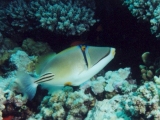 Fish surveys are often conducted by SCUBA divers or snorkellers. A study in the journal Environmental monitoring and assessment has found that these surveys may be inherently inaccurate as snorkellers frighten away the fish they are supposed to be counting.
Researchers from at the University of Victoria, Canada, used an underwater video camera to assess how fish abundance, family richness and community composition were affected by snorkellers and divers on a coral reef in Thailand. They found that snorkellers significantly disturbed the fish they were supposed to be recording. The SCUBA divers didn't provoke the same disturbance. However, only 6 divers were involved in the study so the results are not conclusive.
The researchers suggest that the use of a stationary video camera may help cross-check data that is collected by divers and snorkellers to assess the true family composition and document the presence of rare and easily disturbed species.
Journal Reference:
Environ Monit Assess. 2009 Apr 8
What do you think of this news item? Join a discussion.
Labels: environment, research, SCUBA diving, SCUBA News
Thursday, June 25, 2009
Third of Pelagic Sharks Threatened with Extinction
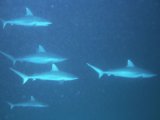 The first study to determine the global conservation status of 64 species of open ocean (pelagic) sharks and rays reveals that 32 percent are threatened with extinction, primarily due to overfishing, according to the IUCN Shark Specialist Group.
“Despite mounting threats, sharks remain virtually unprotected on the high seas,” says Sonja Fordham, Deputy Chair of the IUCN Shark Specialist Group and Policy Director for the Shark Alliance. “The vulnerability and lengthy migrations of most open ocean sharks mean they need coordinated, international conservation plans. Our report documents serious overfishing of these species, in national and international waters, and demonstrates a clear need for immediate action on a global scale.”The report comes days before Spain hosts an international summit of fishery managers responsible for high seas tuna fisheries in which sharks are taken without limit. It also coincides with an international group of scientists meeting in Denmark to formulate management advice for Atlantic porbeagle sharks.
The study reports the Great Hammerhead (Sphyrna mokarran) and Scalloped Hammerhead (Sphyrna lewini) sharks, as well as Giant Devil Rays (Mobula mobular), as globally Endangered and facing a very high risk of extinction in the wild. Smooth Hammerheads (Sphyrna zygaena), Great White (Carcharodon carcharias), Basking (Cetorhinus maximus), Oceanic Whitetip (Carcharhinus longimanus), two species of Mako (Isurus spp.) and three species of Thresher (Alopias spp.) sharks are classed as globally Vulnerable to extinction ( facing a high risk of extinction in the wild).

Scalloped hammerhead (Sphyrna lewini)
(Image: Simon Rogerson)
Many open ocean sharks are taken mainly in high seas tuna and swordfish fisheries. Once considered only incidental “bycatch”, these species are increasingly targeted due to new markets for shark meat and high demand for their valuable fins, used in the Asian delicacy shark fin soup. To source this demand, the fins are often cut off sharks and the rest of the body is thrown back in the water, a process known as “finning”. Finning bans have been adopted for most international waters, but lenient enforcement standards hamper their effectiveness.
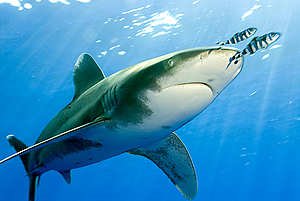
Oceanic Whitetip (Carcharhinus longimanus)
(Image: Simon Rogerson)
Sharks are particularly sensitive to overfishing due to their tendency to take many years to mature and have relatively few young. In most cases, pelagic shark catches are unregulated or unsustainable.
The IUCN Shark Specialist Group is calling on governments to set catch limits for sharks and rays based on scientific advice and the precautionary approach. It further urges governments to fully protect Critically Endangered and Endangered species of sharks and rays, ensure an end to shark finning and improve the monitoring of fisheries taking sharks and rays.

Silky (Carcharhinus falciformis)
(Image: Jeremy Stafford-Deitsch)
The IUCN uses a series of categories to classify species
| EXTINCT | The last individual has died |
| EXTINCT IN THE WILD | Only survives in captivity or cultivation |
| CRITICALLY ENDANGERED | Facing an extremely high risk of extinction in the wild |
| ENDANGERED | Facing a very high risk of extinction in the wild |
| VULNERABLE | Facing a high risk of extinction in the wild |
| NEAR THREATENED | Likely to qualify for, a threatened category in the near future |
| LEAST CONCERN | Does not qualify for any of the above |
is the world’s largest global environmental network. It is a
membership union with more than 1,000 government and
non-governmental member organisations and almost 11,000
volunteer scientists in more than 160 countries.
Further Reading:
The Conservation Status of Pelagic Sharks and Rays: Report of the IUCN Shark Specialist Group Pelagic Shark Red List Workshop
IUCN Red List Categories and Criteria booklet
Related Stories:
EU launches shark protection plan
Caribbean Big Fish Disappearing
Mediterranean Sharks Declining Fast
Mexico Passes Shark Finning Ban
Four Times more Sharks caught than Officially Reported
What do you think of this news item? Join a discussion.
Labels: fish, marine biology, research, SCUBA News, sealife, sharks
Thursday, May 21, 2009
Endangered right whales found where they were thought extinct
 Using a system of underwater hydrophones that can record sounds from hundreds of miles away, a team of scientists has documented the presence of endangered North Atlantic right whales in an area they were thought to be extinct.
The discovery is particularly important, researchers say, because it is in an area that may be opened to shipping if the melting of polar ice continues, as expected.
Results of the study were presented this week at a meeting of the Acoustical Society of America.
The scientists from Oregon State University and the National Oceanic and Atmospheric Administration are unsure of exactly how many whales were in the region, which is off the southern tip of Greenland and site of an important 19th-century whaling area called Cape Farewell Ground. But they recorded more than 2000 right whale vocalizations in the region from July to December of 2007.
“The technology has enabled us to identify an important unstudied habitat for endangered right whales and raises the possibility that – contrary to general belief – a remnant of a central or eastern Atlantic stock of right whales still exists and might be viable,” said David Mellinger, chief scientist of the project.
“We don’t know how many right whales there were in the area,” Mellinger added. “They aren’t individually distinctive in their vocalizations. But we did hear right whales at three widely space sites on the same day, so the absolute minimum is three. Even that number is significant because the entire population is estimated to be only 300 to 400 whales.”
Only two right whales have been sighted in the last 50 years at Cape Farewell Ground, where they had been hunted to near extinction prior to the adoption of protective measures.
The pattern of recorded calls suggests that the whales moved from the southwest portion of the region in a northeasterly direction in late July, and then returned in September – putting them directly where proposed future shipping lanes would be likely.
Right whales are the most endangered large whale and vulnerable to collisions with ships as they ignore general ship sounds. Alarm sirens intended to scare them away from ships may actually be more likely to cause a collision, as the whales have been shown to rush to the surface when they hear the alarm.
Related News:
Lawsuit Filed to Protect World's Most Endangered Whale
What do you think of this news item? Join a discussion.
Labels: research, SCUBA News, whale and dolphins
Tuesday, May 19, 2009
Basking shark mystery solved
"While commonly sighted in surface waters during summer and autumn months, the disappearance of basking sharks during winter has been a great source of debate ever since an article in 1954 suggested that they hibernate on the ocean floor during this time," said Gregory Skomal of Massachusetts Marine Fisheries. "Some 50 years later, we have helped to solve the mystery while completely re-defining the known distribution of this species."
Using new satellite-based tagging technology, the researchers found that basking sharks make ocean-scale migrations through tropical waters of the Atlantic Ocean during the winter, travelling at depths of 200 to 1,000 meters. Their data show that the sharks sometimes stay at those depths for weeks or even months at a time.
"In doing so, they have completely avoided detection by humans for millennia," Skomal said
The discovery was the result of marking 25 basking sharks off the coast of Cape Cod with satellite tags and studying their movements. The migratory paths of the sharks were then estimated by coupling tag data with a novel geo-positioning technology technique.
Several factors had made basking sharks a challenge to study. On top of the fact that they disappear for long periods of time, they also feed exclusively on plankton. That means they can't readily be captured with traditional rod-and-reel methods. And even when the sharks are found closer to the ocean surface, they spend their time in the cool-temperature, plankton-rich waters that limit underwater visibility and make diving difficult.
The basking shark is the second largest shark after the whale shark. It filters plankton through its gills whilst swimming with its huge mouth open.
Journal Reference:
Transequatorial Migrations by Basking Sharks in the Western Atlantic Ocean. Skomal, Gregory B.; Zeeman, Stephen I.; Chisholm, John H.; Summers, Erin L.; Walsh, Harvey J.; McMahon, Kelton W.; Thorrold, Simon R.
doi:10.1016/j.cub.2009.04.019
What do you think of this news item? Join a discussion.
Labels: research, SCUBA News, sharks
Monday, May 18, 2009
World's Largest Leatherback Turtle Population Found
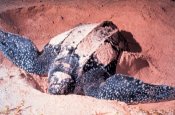 An international team of scientists has identified a nesting population of leatherback sea turtles in Gabon, West Africa as the world's largest.
The research, published in the May issue of Biological Conservation, involved country-wide land and aerial surveys that estimated a population of between 15,730 and 41,373 female turtles using the nesting beaches.
The study highlights the importance of conservation work to manage key sites and protected areas in Gabon.
Leatherbacks are of profound conservation concern around the world after populations in the Indo-Pacific crashed by more than 90 percent in the 1980s and 1990s. The International Union for Conservation of Nature (IUCN) lists leatherback turtles as critically endangered globally, but detailed population assessments in much of the Atlantic, especially Africa, are lacking.
During three nesting seasons between 2002 and 2007, the team’s members carried out the most comprehensive survey of marine turtles ever conducted in Gabon. This involved aerial surveys along Gabon’s 600 km (372 mile) coast, using video to capture footage for evaluation, and detailed ground-based monitoring. By covering the entire coastline, they were not only able to estimate the number of nests and nesting females, but also to identify the key sites for leatherback nesting, data which are crucial to developing conservation management plans for the species. Leatherbacks were first described nesting in Gabon in 1984.
The study also revealed that around 79 percent of the nesting occurs within National Parks and other protected areas. This gives added hope that Gabon can continue to be one of the world’s most important countries for these magnificent creatures.
Dr Angela Formia of the Wildlife Conservation Society, a co-author of the paper, said: “These findings show the critical importance of protected areas to maintain populations of sea turtles. Gabon should be commended for creating a network of National Parks in 2002 that have provided a sanctuary for this endangered species as well as other rare wildlife.”
The leatherback is the largest sea turtle, reaching up to nearly two metres (6.5 feet) in length and 540kg (1190 pounds) in weight. Unlike other sea turtles, the leatherback does not have a hard shell. Its shell is made-up of a mosaic of small bones covered by firm, rubbery skin with seven longitudinal ridges. Leatherbacks are the most widely spread marine turtles, and are found in the Pacific, Indian and Atlantic oceans, particularly in tropical regions. They are also the deepest diving of all sea turtles. The deepest recorded dive is 1.2 kilometres (3/4 mile), which is slightly more than the deepest known dive of a sperm whale.
As with other reptiles, the sex of leatherbacks is determined by the temperature of eggs during incubation. With leatherbacks, temperatures above 29 degrees centigrade (84 degrees Fahrenheit) will result in female hatchlings.
Leatherbacks are strong swimmers and tagged individuals have been known to cross ocean basins and are known to travel many thousands of kilometres in search of their jellyfish prey.
To see turtles currently being tracked from Gabon see: http://www.seaturtle.org/tracking/?project_id=340
The research was led by the University of Exeter working in collaboration with the Wildlife Conservation Society (WCS) which spearheads the Gabon Sea Turtle Partnership, a network of organisations concerned with the protection of marine turtles in Gabon.
Related News:
California waters for leatherback turtles?
What do you think of this news item? Join a discussion.
Labels: Africa, research, SCUBA News, sealife, turtles
Wednesday, May 06, 2009
Caribbean Big Fish Disappearing
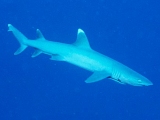 Sharks, barracuda and other large predatory fishes disappear on Caribbean coral reefs as human populations rise, endangering the region's marine food web and ultimately its reefs and fisheries, according to a study published today in the journal PLoS One.
While other scientists working in the Caribbean have observed the declines of large predators for decades, the new study by Chris Stallings documents the ominous patterns geographically in much more detail than other research to date.
“I examined 20 species of predators, including sharks, groupers, snappers, jacks, trumpetfish and barracuda, from 22 Caribbean nations,” said Stallings, a postdoctoral associate at the FSU Coastal and Marine Laboratory. “I found that nations with more people have reefs with far fewer large fish because as the number of people increases, so does demand for seafood. Fishermen typically go after the biggest fish first, but shift to smaller species once the bigger ones become depleted. In some areas with large human populations, my study revealed that only a few small predatory fish remain.”
Stallings said that although several factors — including loss of coral reef habitats — contributed to the general patterns, careful examination of the data suggests overfishing as the most likely reason for the disappearance of large predatory fishes across the region. He pointed to the Nassau grouper as a prime example. Once abundant throughout the Caribbean, Nassau grouper have virtually disappeared from many Caribbean nearshore areas and are endangered throughout their range.
“Large predatory fish such as groupers and sharks are vitally important in marine food webs,” Stallings said. “However, predicting the consequence of their loss is difficult because of the complexity of predator-prey interactions. You can't replace a 10-foot shark with a one-foot grouper and expect there to be no effect on reef communities. Shifts in abundance to smaller predators could therefore have surprising and unanticipated effects. One such effect may be the ability of non-native species to invade Caribbean reefs.”
A case in point, said Stallings, is the ongoing invasion by Pacific lionfish, which were introduced by aquarium releases.
“Lionfish are minor players on their native Pacific reefs, yet they are undergoing a population explosion and overeating small fishes in the greater Caribbean region,” said Professor Mark Hixon of Oregon State University, Stallings' doctoral advisor at OSU. “Preliminary evidence suggests that lionfish are less invasive where large predatory native fishes are abundant, such as in marine reserves,” Hixon said.
The study also demonstrates the power of volunteer and community research efforts by non-scientists. Stallings used data from the Reef Environmental Education Foundation's (REEF) online database, which contains fish sightings documented by trained volunteer SCUBA divers, including more than 38,000 surveys spanning a 15-year period.
Further Reading:
Fish predators of the Caribbean: the curse of too many people, Florida State University
Fishery-Independent Data Reveal Negative Effect of Human Population Density on Caribbean Predatory Fish Communities, PLoS One
What do you think of this news item? Join a discussion.
Labels: Caribbean, research, SCUBA News, sharks
Wednesday, April 22, 2009
Ocean-Going Robotic Submarine Returns
Under the joint CSIRO Wealth from Oceans National Research Flagship and Integrated Marine Observation System (IMOS) project, the underwater ocean glider was launched in February on a two-month, 1,500 kilometre voyage.
With its porpoising motion and an ability to descend to a depth of nearly 1,000 metres, the $A200,000 robotic glider is being trialled in the Tasman Sea and the Indian Ocean as the latest tool in Australia’s $A94 million marine observing network.
The glider’s sensors measure temperature and salinity, as well a range of biological parameters including oxygen and turbidity.
Senior CSIRO Wealth from Oceans Flagship researcher Ken Ridgway, says the Tasman Sea trial has generated new confidence among scientists broadening the array of instruments available to them to better understand the East Australian Current and Leeuwin Currents.
“Ocean currents around Australia are critical to so many aspects of nature and human activity,” Mr Ridgway says. “With the East Australian and Leeuwin Currents, we need to understand how they change from season to season and year to year, and the extent of their influence on local coastal conditions, as this affects climate, weather, fisheries, shipping and more.
Together with data from research vessels, satellites and moored, drifting and expendable instruments, the glider will add a new dimension to profiling the oceans around Australia. But there are still challenges to be overcome.
“In a lot of ways this first deployment is as much learning how to pilot the glider and guide it through and around the eddies of the East Australian Current as it is getting about the data we want,” Mr Ridgway says.
A recent innovation in oceanography, the winged gliders are programmable and guided by Global Positioning Systems. They glide during depth changes, driven by an inflated oil filled chamber. However, because the ocean currents can be faster than the glider’s speed, ensuring they are not swept away has been a difficult process.
“The appeal of these instruments is that they are out working while the scientist can be assessing what is near-real time information about ocean conditions,” Mr Ridgway says.
Stories like this:
Robotic sea glider flies through water
What do you think of this news item? Join a discussion.
Labels: Australia, research, SCUBA News, technology
